Unifying Reasoning and Planning through Energy Minimization

1 The University of Texas at Dallas 2 Harvard University
NeurIPS 2026

TL;DR

Energy Minimization Search (EMS) learns a single fixed energy landscape for each task and solves problems by searching it. The same training framework supports reasoning and planning, with additional inference compute allocated to more refinement steps or more candidate solutions. On reasoning benchmarks, EMS matches or outperforms the evaluated diffusion-based EBM baselines in solution quality with substantially fewer model evaluations.

Abstract

Neural networks often struggle to solve reasoning and planning problems more complex than those encountered during training. Energy-based models offer a natural approach to this challenge by learning objectives that can be optimized with additional computation. However, existing methods rely on specialized training and inference procedures, from differentiating through iterative optimization to annealing across noise-dependent energy landscapes. We introduce Energy Minimization Search (EMS), a unified framework for reasoning and planning through a shared training objective and time-invariant energy minimization. EMS combines Equilibrium Matching with contrastive supervision to learn an energy function for each task, using the energy values to evaluate candidates and energy gradients to guide refinement. At inference time, we search on this fixed landscape, allocating additional computation to more refinement steps or candidate solutions. Across graph coloring, N-Queens, 3-SAT, crosswords, path finding, and maze navigation, EMS achieves competitive or improved solution quality relative to baselines, with substantially fewer function evaluations than the diffusion-based EBM reasoning baselines.
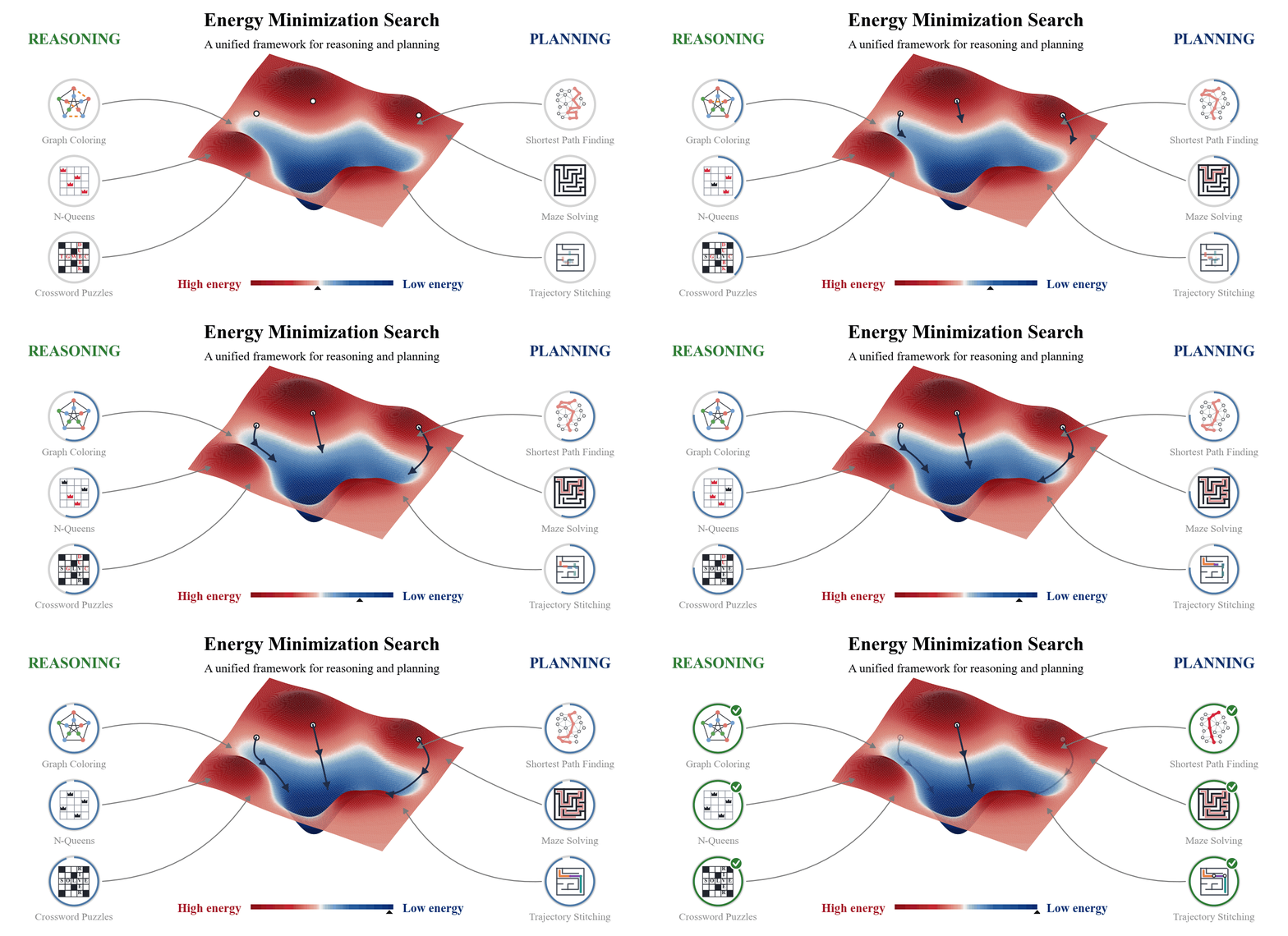
Energy Minimization Search unifies reasoning and planning through a fixed energy landscape. Reasoning examples include graph coloring, N-Queens, and crossword puzzles; planning examples include shortest path finding, maze solving, and trajectory stitching.
Unifying reasoning and planning through energy minimization. EMS learns a time-independent energy function for each task and refines candidate assignments or trajectories on the resulting landscape. The white dot represents initial candidate solutions. The arrows illustrate successive refinement toward a low-energy solution, showing how a problem is solved by minimizing each candidate's energy. EMS can refine multiple candidates in parallel, then select the lowest-energy candidate for evaluation.

Reasoning and planning share a search problem

Reasoning and planning both require finding solutions that satisfy problem conditions. Prior diffusion-based EBMs refine candidates across a sequence of noise-conditioned energy landscapes, which can require many model evaluations at inference. EMS instead learns a fixed energy function for each task: energy values score candidates, while gradients guide their refinement. The same training framework supports both domains, and the search method and compute budget can change without retraining.

Reasoning

We evaluate EMS on graph coloring, N-Queens, 3-SAT, and crosswords, composing learned local energies to search for complete solutions. Across these tasks, EMS achieves competitive or improved solution quality with substantially fewer model evaluations than the evaluated diffusion-based EBM baselines.
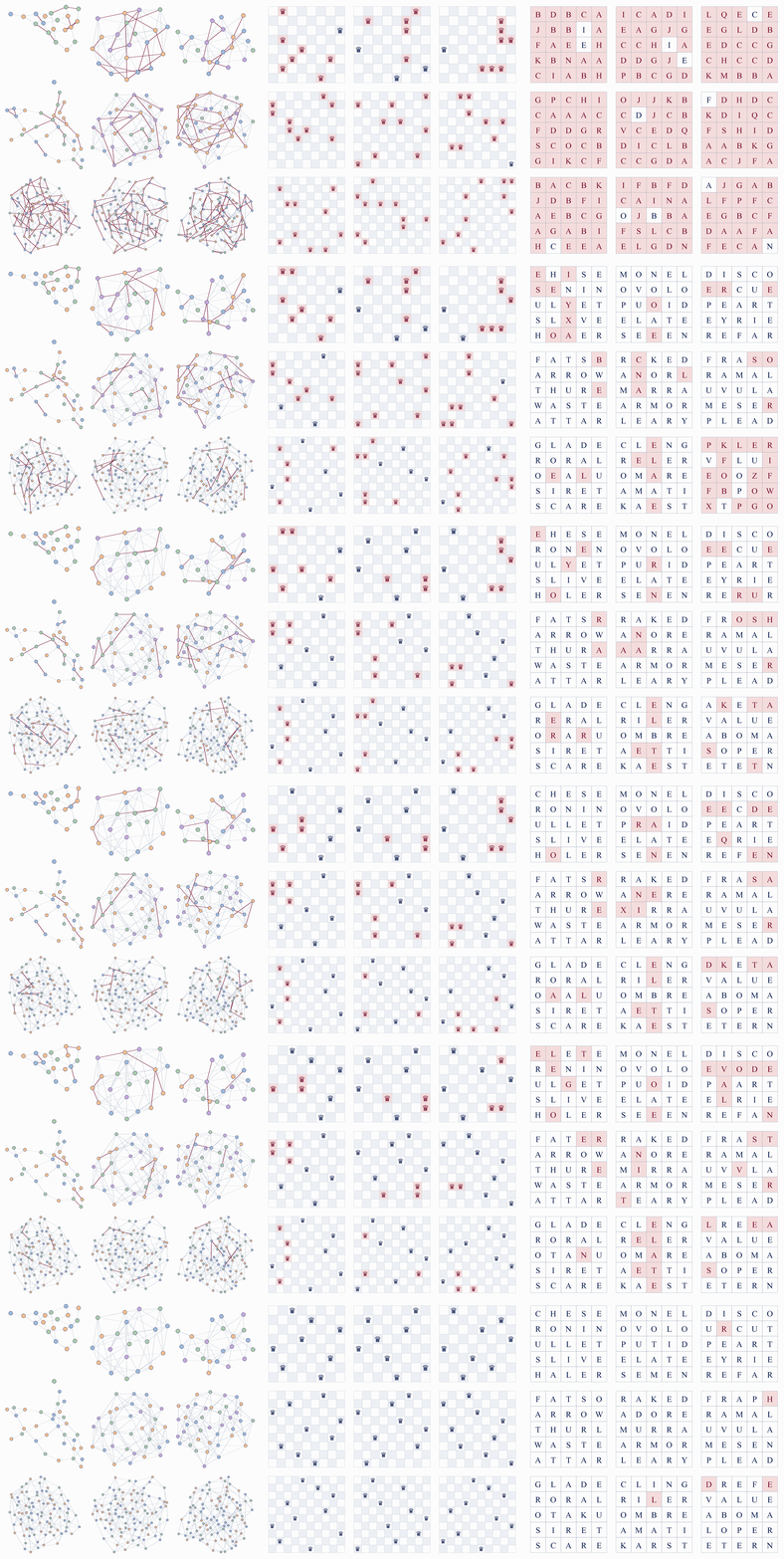
Recorded EMS refinement of nine graph colorings, nine N-Queens boards, and nine crosswords. All graph and queen examples finish solved; five crosswords finish fully correct and four retain errors.
Reasoning refinement samples. Graph coloring, 8, 9, 10-Queens, and crosswords, left to right. Red marks conflicts or incorrect letters. Pale red cells clear as errors resolve as energy is minimized. All graphs and queen boards finish solved, alongside five of nine crosswords.

Reasoning results across baselines

Reported reasoning baselines in burgundy and EMS in navy. EMS has the fewest mean graph-coloring conflicts and the most solved 8-Queens boards and 3-SAT formulas among the shown comparisons. EMS and DiffEBM tie for the highest crossword letter accuracy at 80.4%.
Reasoning results. Red bars show reported baselines. Blue shows EMS. Graph-coloring conflicts are averaged across eight distributions (lower is better). Higher is better for the other tasks. Evaluation reductions compare EMS with DiffEBM and count model evaluations across all candidates, resulting in subsantially less compute. Full settings are in the paper.

Planning

EMS searches over graph paths and continuous trajectories. EMS outperforms all baselines shown in these planning comparisons, with modest gains in first-action accuracy and mean goal-reaching success. The same model trained on 15-node graphs improves accuracy on both 15- and 25-node graphs. On PointMaze, EMS improves on Decision Diffuser, although success remains low on Large mazes.
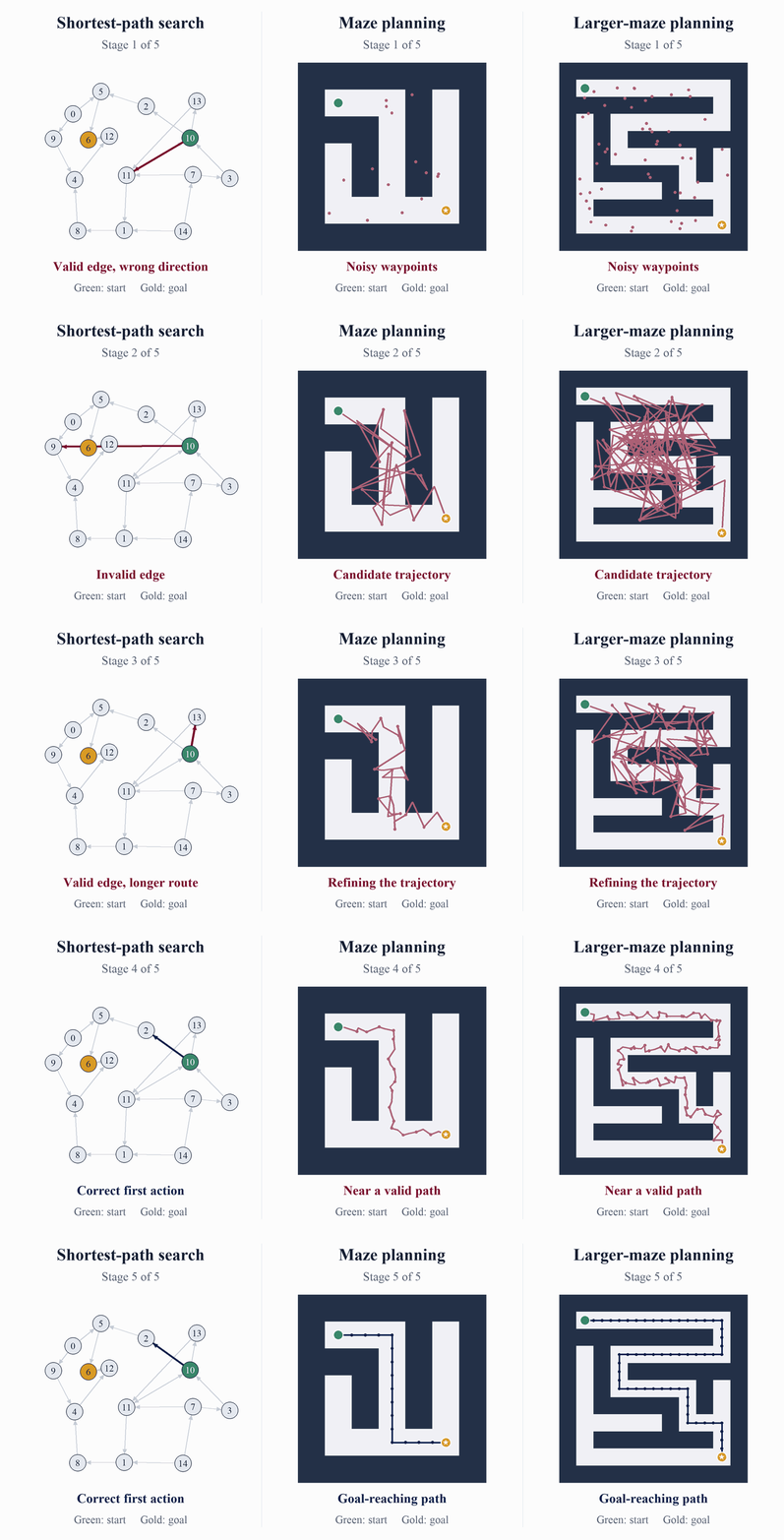
Five-stage schematic of selecting a correct first action in a directed graph and refining waypoint trajectories through two illustrative mazes. These are not recorded model rollouts.
Planning through energy minimization. Minimizing energy refines candidate actions and trajectories toward valid plans.

From graph search to continuous trajectories

Planning baselines in burgundy and EMS in navy. Path-finding accuracy for Diffusion, IREM, IRED, and EMS is 45.2, 90.4, 92.6, and 96.3 percent on 15-node graphs, and 46.9, 88.4, 91.9, and 93.1 percent on 25-node graphs. Decision Diffuser versus EMS maze success is 30.00 versus 33.67 percent on Medium and 0.00 versus 8.86 percent on Large.
Planning results. Red bars show baselines. Blue shows EMS. Improvements are percentage-point gains over IRED for path finding and Decision Diffuser (DD) for mazes. Graph results measure first-action accuracy, not complete-path execution. Maze results show five-seed means with standard-deviation error bars. Full settings are in the paper.

Method

Animated overview of the Energy Minimization Search method.
Learning an energy landscape for search. Equilibrium Matching trains energy gradients to guide corrupted candidates toward valid solutions. Optional contrastive supervision encourages valid solutions to have lower energy than perturbed alternatives. At inference, EMS refines candidates on the learned landscape, optionally summing local energies to account for multiple constraints. The objective stays fixed throughout search.

Citation

@inproceedings{rodriguez2026ems,
  title     = {Unifying Reasoning and Planning through Energy Minimization},
  author    = {Rodriguez, Adrian and Kim, Angelica and Guo, Yunhui and Du, Yilun},
  booktitle = {Advances in Neural Information Processing Systems},
  year      = {2026}
}