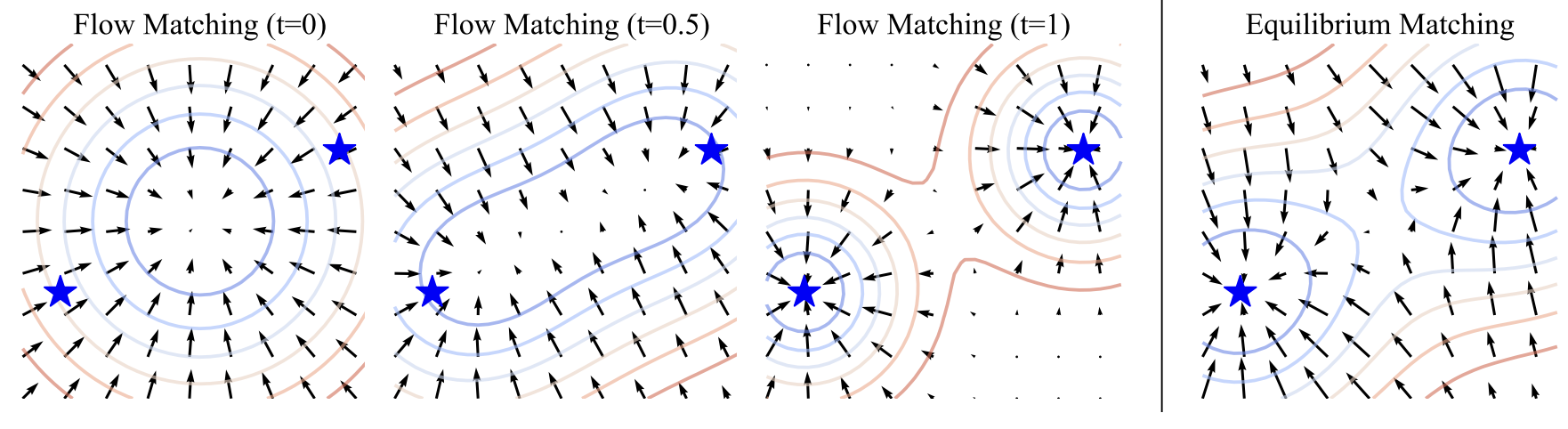
An Energy-Based Model (EBM) evaluates a proposed output for a given input and returns a single number, called its energy. Lower energy indicates a better fit to the input. In a neural EBM, a network learns this scoring function from data. For example, a robot-planning model can score an entire proposed sequence of states and actions, called a trajectory, given a starting state and a goal.
To make a prediction, we start with an initial guess and repeatedly adjust the proposed output to reduce its energy. For the robot, we change the proposed states and actions while keeping the starting state, goal, and learned network weights fixed. Gradients tell us how small changes to the trajectory affect its energy, so we can use them to guide these updates. This search for an output with the lowest energy is called energy minimization.
The same energy function can also define a probability distribution over possible outputs. Exponentiating the negative energy gives each output a positive weight, so lower-energy outputs receive larger weights. Dividing by the sum or integral of these weights, called the partition function, normalizes the distribution. A sampling procedure can then generate different plausible outputs according to this distribution.
An EBM represents a probability distribution through a single energy function over complete outputs. Autoregressive models factorize the distribution into a product of conditional probabilities, each conditioned on the variables generated so far. Diffusion models introduce noisy intermediate states and factorize the generative process into conditional transitions that progressively remove noise. An EBM does not require either a variable ordering or a sequence of noise levels to define its distribution. Because the energy scores all output variables together, it provides a direct way to represent global dependencies among them. This simple representation comes at a computational cost. Maximum-likelihood training typically requires repeated sampling from the current model, which can be slow and difficult in high dimensions.
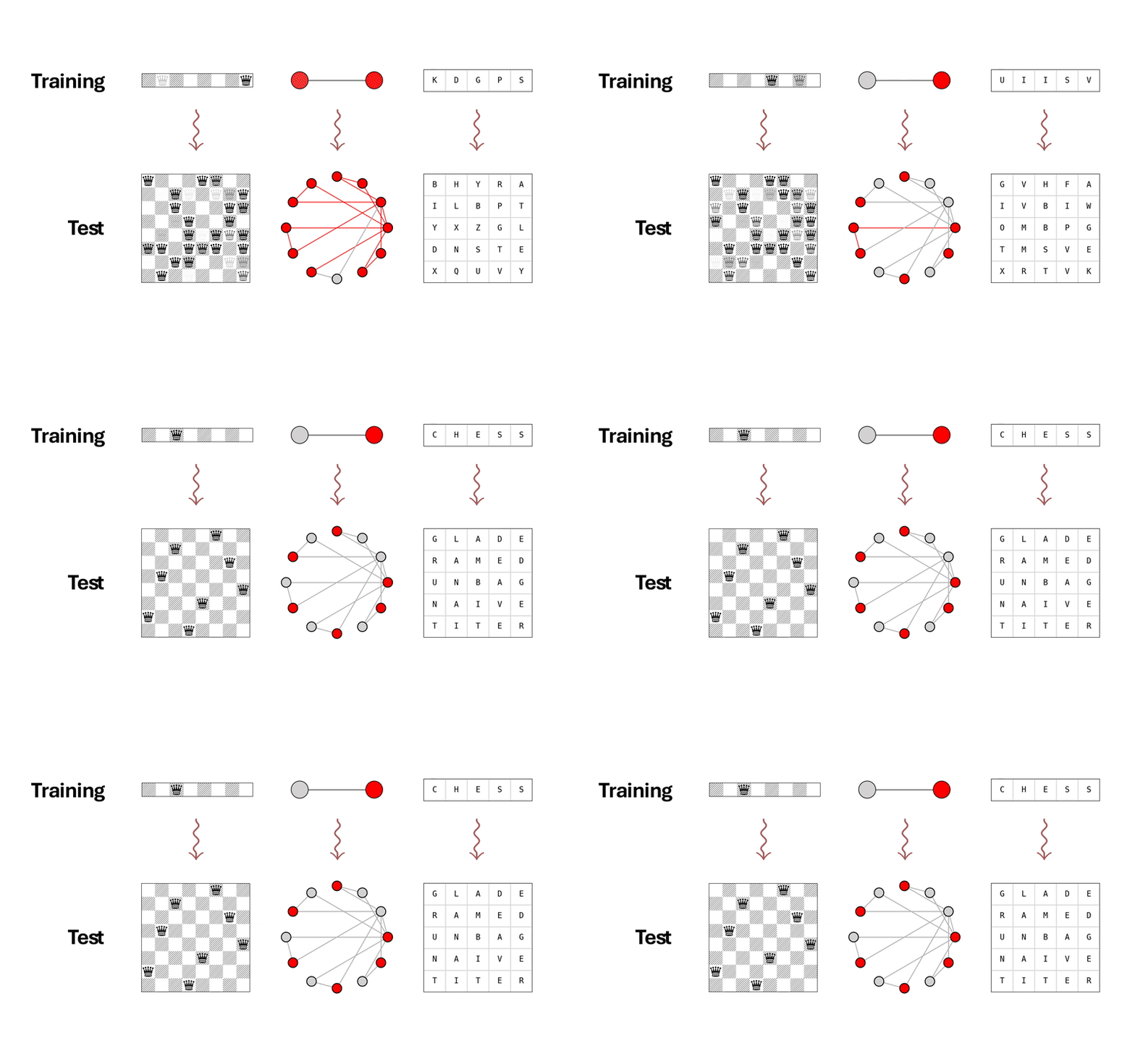
We can also evaluate the same candidate with several energy functions. In robot planning, one energy can assess whether a trajectory follows the robot’s dynamics, meaning how states change under actions, and another can score how close its final state is to a goal. Adding the energies gives a single score for both requirements. We then adjust the trajectory to reduce this total energy. Weights control the balance between the requirements. Changing the goal energy creates a new planning problem without retraining the dynamics model.
My PhD thesis, Learning Generalizable Systems by Learning Composable Energy Landscapes, develops this approach: learning reusable energy landscapes from data, then composing and optimizing them at inference time to solve tasks not represented directly in the training set.
Flexible representationOne function scores complete candidate outputs and can define a probability distribution over them.
Multiple inference proceduresChange a proposed output to reduce its energy, or sample several plausible outputs from the distribution.
CompositionAdd scores for different requirements and search for an output with low total energy.